Remembering early contributions to disability rights activism in Canadian history

Written by Eric Story, Special to Western News, November 10, 2025
Perhaps you’ve heard the name John McCrae, the famous poet who wrote “In Flanders Fields.”
But have you heard of George Hincks and Marshall McDougall?
While conducting research on disabled veterans, I came across their names in an old veterans’ magazine that briefly mentioned their plan to hike from Calgary to Ottawa in 1923. Curious, I searched the microfilmed newspapers to find out what became of their journey.
As it turned out, these two ex-servicemen of the the First World War (1914–18) hiked more than 2,000 kilometres to raise awareness of the issues facing disabled veterans after the war.
Historians have typically identified the birth of the disability rights movement in the post-1945 period.
But the forgotten hike of Hincks and McDougall and the related advocacy efforts of the Amputations Association of the Great War — a predecessor organization of today’s War Amps — speaks to an earlier generation of activism that remains largely untold.
The journey begins
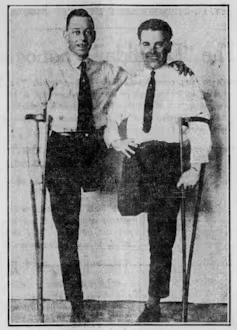
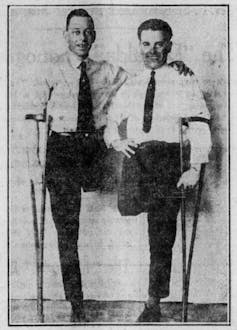
Calgary’s Daily Herald was the first to report on Hincks and McDougall. It published a striking photograph of the two men before their hike, smiling and standing shoulder to shoulder. What draws the reader’s attention, however, is the lower half of the picture. Both men are amputees, each having lost a leg on the First World War battlefields.
To understand what drove these two disabled men to embark on such an arduous journey, we must turn to the 19th century, when Canada began to transition its economy away from rural agricultural production towards urban industrial capitalism.
As cities industrialized in the second half of the 19th century, the nexus of the Canadian economy shifted from the home to the factory floor. Historian Sarah Rose has examined how this shift impacted disabled peoples’ ability to work in a newly industralized economy.
Employers began to prioritize able-bodied labourers for their strength, skill and what Rose calls “interchangeable” bodies, which alienated many disabled people from the workforce.
By the eve of the First World War, Canada’s economic transformation had cast people with disabilities as inefficient workers and, ultimately, unproductive members of society.
Challenging notion of being ‘unproductive’
At a time of rigid social and identity roles, if men could not independently earn a wage and support their families, they risked being labelled as unproductive.
When a reporter asked why Hincks and McDougall were making their trek, Hincks answered: “Primarily, it is to prove that an amputation case has as much stamina as the average citizen who has not lost a faculty.”
Despite being unemployed, he saw their journey as a direct challenge to the notion that he and McDougall were somehow unproductive members of society.
Trek after surviving Western Front
Two weeks after the men’s departure from Calgary, a Medicine Hat News reporter observed their blistered hands and feet, aching muscles and sore armpits rubbed raw from the padding of their crutches when they arrived in Medicine Hat, Alta.
But Hincks and McDougall were no strangers to pain.
Hincks lost his left leg in 1915 after a German machine gunner pumped 36 bullets into it at the Second Battle of Ypres. His bullet-riddled leg was amputated at a prisoner of war camp later that spring.
At the Battle of Cambrai in 1918, a spinning piece of shrapnel lodged deep into McDougall’s right leg. His doctor immediately opted for surgery, amputating his leg the same day.
Despite their aches and pains at Medicine Hat, Hincks and McDougall carried on.
Camaraderie among amputees
Nearly three weeks later, the Morning Leader reported their arrival in Regina, Sask., where they were greeted by fellow veteran P.J. Brotheridge. Having lost his arm in the war, he invited Hincks and McDougall to stay with him before their departure the following day.
These interpersonal connections suggest a certain camaraderie among war amputees, finding commonality in the shared experience of living without a limb.
These shared experiences of disability led to the formation of the Amputations Association of the Great War in 1920. Brotheridge, Hincks and McDougall were all members when the hikers passed through Regina.
Speech about disabled veterans
On the hottest day of the summer, the exhausted duo arrived at their final destination on the Prairies — Winnipeg.
According to a story in the Winnipeg Evening Tribune, Hincks’ gave a bold and impassioned speech about the struggles of disabled veterans to a crowd at the Fort Garry Hotel. He said:
“The veteran with an amputated limb is unable to compete in the employment market … He is under the handicap of visibility of disability.”
Instead of instructing his fellow disabled veterans to overcome the barriers they faced in Canadian society, he asked able-bodied Canadians to confront their own ableist prejudices that kept war amputees like him from attaining gainful employment in post-war Canada.
In testimony before the House of Commons in the 1920s, the Amputations Association had already voiced these concerns. They argued that the visibility of their members’ disabilities made it easier for prospective employers to discriminate against them and refuse their employment.
These prejudicial attitudes were the same ones that disability rights advocates confronted 50 years later.
The end of the road
The Globe reported that Hincks and McDougall reached the Manitoba-Ontario border in mid-June, heading east towards Kenora, Ont. for the last leg of their hike.
But Kenora would actually mark the beginning of the end of their journey across Canada.
Plagued with worsening pain in his leg, McDougall decided then that his part in the hike was finished.
But Hincks pressed on. He walked several hundred kilometres more to the western shores of Lake Superior. Nearly 60 days after he and McDougall departed from Calgary, The Globe printed a front-page story from present-day Thunder Bay headlined: “One Legged Hikers Forced to Quit.”
The 1923 protest hike was over.
Even though they never reached their desired destination, Hincks and McDougall’s journey across Canada more than 100 years ago is a testament to the determination of two war amputees to bring awareness to the challenges disabled veterans faced in post-war life.
On this Remembrance Day, let’s remember not only Hincks’ and McDougall’s wartime service, but also their early contributions to disability rights activism in Canadian history.
Eric Story, Postdoctoral researcher, Department of History, Western University
This article is republished from The Conversation under a Creative Commons license. Read the original article.
Expert Insight reflects the perspective and scholarly interest of Western faculty members and is not an articulation of official university policy on issues being addressed.