
Written by John Morris, WheelchairTravel.org, April 20, 2026
The Airbus Airspace U Suite, tested in the air last month and demoed at the Aircraft Interiors Expo, could be the future of air travel for wheelchair users
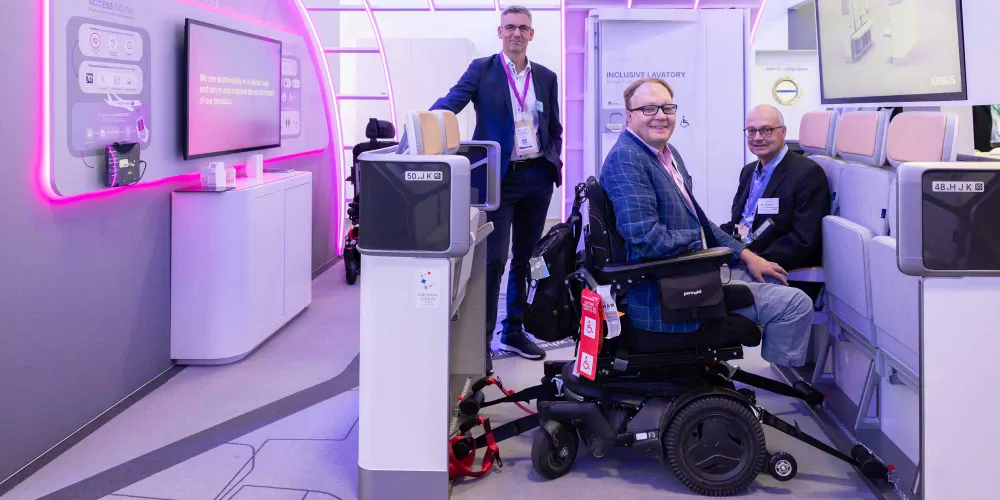
There is a version of air travel that most wheelchair users have never experienced: one in which you board an airplane, roll into a designated wheelchair securement space and fly — without transferring into a narrow aisle chair, surrendering your wheelchair at the gate and wondering what condition it will be in when you land. That experience does not yet exist, but Airbus brought that dream much closer to reality at the 2026 Aircraft Interiors Expo (AIX) in Hamburg, Germany.

I visited the Airbus stand at AIX and secured my Permobil F3 power wheelchair inside the full-scale mockup of the company’s Airspace U Suite. Until now, the U Suite has been just a digital rendering, but at AIX it became tangible. Developed over several years by Airbus engineers Hans-Gerhard Giesa and Dirk Meiranke, the concept’s prime position at AIX is evidence of just how seriously the aircraft manufacturer is considering the inclusion of wheelchair users in its designs for the next generation of passenger air travel.
What is the Airspace U Suite by Airbus?
The Airspace U Suite is Airbus’s answer to one of the most persistent failures in commercial air travel: the exclusion of personal wheelchairs from the aircraft cabin. Today, wheelchair users are required to transfer out of their chairs at the aircraft door, squeeze into a narrow aisle chair and then transfer again into a standard seat — all while their mobility device is loaded into the cargo hold. Thousands of those chairs won’t make it through undamaged, with over 10,000 personal wheelchairs damaged each year in the United States alone.
The U Suite concept would enable disabled travelers to remain in their own personal wheelchair throughout the flight, secured directly to the aircraft floor. It would eliminate the need for wheelchair transfers and reduce the risk of wheelchair damage. Most importantly, this and other wheelchair securement solutions would grant greater independence to disabled passengers.
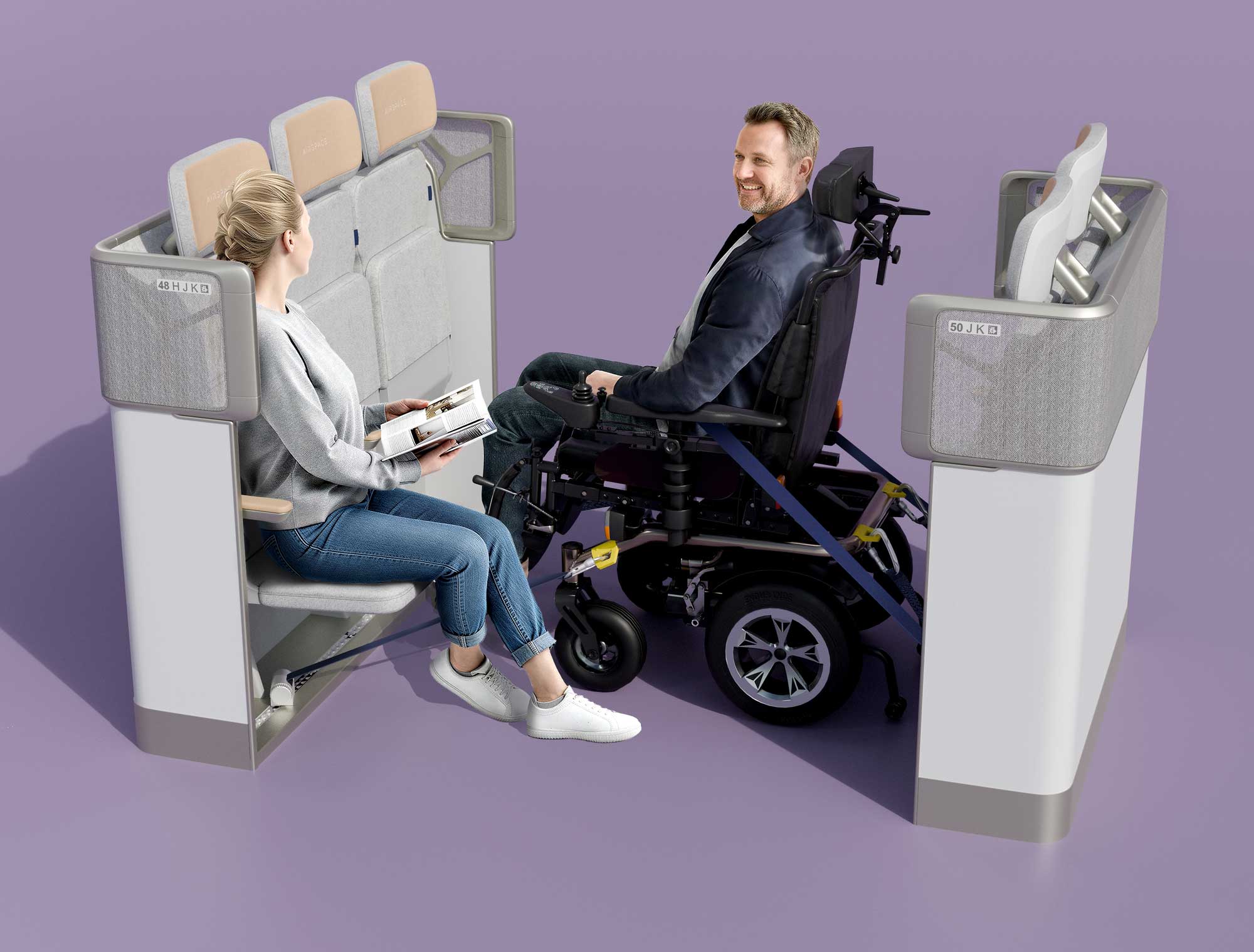
The seating concept itself is flexible in ways that distinguish it from competing wheelchair securement solutions. The same footprint can serve a wheelchair user in their own wheelchair, a tired traveler looking to lay down or a family wanting to spread out together. Airbus is not positioning the U Suite as a disabled-only zone carved out of the standard cabin, but as a premium, multi-use area that could be used to accommodate a wheelchair user when necessary.
Do you find value in this reporting? It is only possible with the support of readers and paid subscribers who join the Wheelchair Travel team. To back my work in advocating for a future where travel is accessible, please consider upgrading to a paid subscription or making a one-time or recurring gift via PayPal.
In an industry first, the Airspace U Suite has been tested inflight
What sets the U Suite apart from every other wheelchair securement concept currently in development is that it has already left the ground. In early March 2026, Airbus employee Dirk Thalheim, who uses a wheelchair in real life, flew during the cruise phase of a test flight aboard the “Airspace Explorer,” the company’s Airbus A350-900 test aircraft.

Thalheim boarded the aircraft using an AmbuLift or “high-loader,” which is a specialized airport vehicle with a hydraulic cabin that lifts disabled passengers from ground level to the aircraft door (these are commonly used in European and other international airports). After rolling onboard, the wheelchair was secured to the floor tracks with the specialized restraint system designed for use in the Airspace U Suite.
Airbus elected to test the wheelchair and securement system unoccupied during taxi, takeoff and landing on this first flight but, once airborne, Thalheim returned to and sat in his wheelchair. That marked a significant world-first.
Other securement concepts, including the Prime+ Accessibility Platform from Collins Aerospace and Air4All from Delta Flight Products, remain in mockup and have not yet taken flight. While Airbus certainly has years of significant work ahead in certifying a product for use by commercial airlines, their March test proved that the U Suite is more than a PR concept for display in an exhibition hall. It is a real solution that has now been tested up in the air.
Testing the U Suite Mockup
At the Airbus stand, I was invited to roll my Permobil F3 power wheelchair into the full U Suite mockup and experience the securement process. The space accommodated my chair without difficulty and the restraint system, developed in partnership with AMF Bruns (a Q’Straint competitor), was easily engaged.
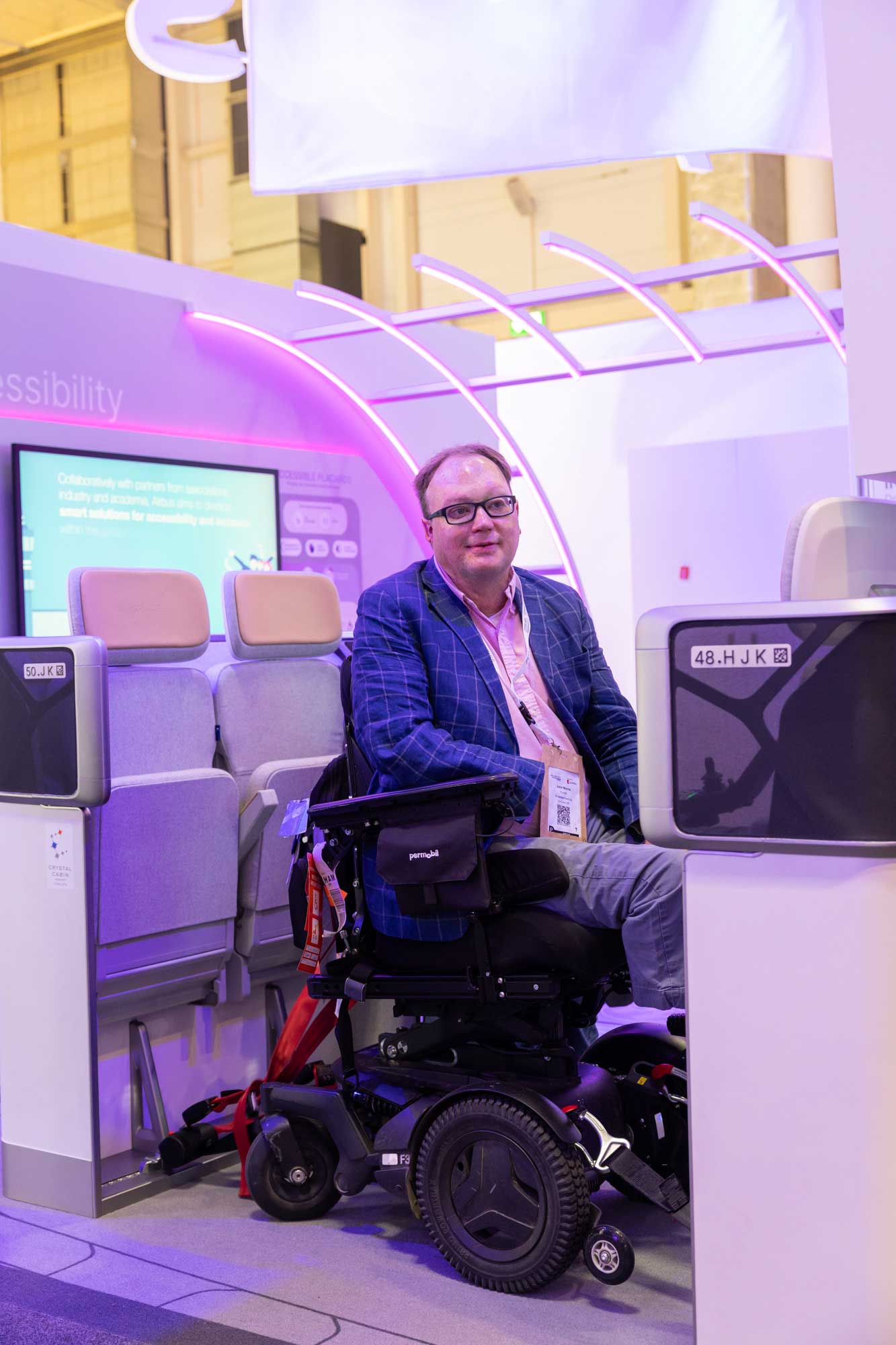
The space was designed with intentionality and felt premium, rather than like a last row compromise. The intention to market this as a desirable space for multiple passenger types, not merely as means to meet future standards for accommodating wheelchair users, was evident in the physical design and product presentation.
Airline executives are paid to attend events like the Aircraft Interiors Expo, but I have to pay my own way. If you want the disability community represented at industry conferences, please upgrade to a paid membership or make a one-time or recurring gift via PayPal. I can’t do this work without your support.
The Road to Airlines and to Certification
The U Suite was recognized as a finalist in the Accessibility category at the 2026 Crystal Cabin Awards, the aviation industry’s most respected recognition for cabin innovation.
In a press release highlighting the U Suite’s debut at AIX, Airbus noted that it “plans to work with aviation authorities towards a certification path for all the elements necessary for the safe operation of passenger owned wheelchairs while traveling.” The company has targeted 2032 — six years from now — as the date for a potential first delivery to an airline customer.
That date will frustrate many Wheelchair Travel readers, but it is significant in that it is the first time a company has set a true target date for the launch of a wheelchair securement solution in the aircraft cabin.
Final Thoughts
I have closely followed wheelchair securement concepts for airplanes since I was the first to report on Delta Flight Products’s Air4All concept in 2023. Over the past three years, I have tested mockups, interviewed engineers, tracked FAA certification processes, toured development facilities and watched the field grow from a single mockup to a genuine multi-company competition. Progress has been real but slow, and the gap between a mockup in Hamburg and the aircraft cabin has felt wider than we would like.
After testing the Airbus U Suite, that gap feels meaningfully narrower. A power wheelchair has now flown inside the cabin of a real aircraft. For wheelchair users, that is the most encouraging thing I can say after four days in Hamburg: for the first time ever, a wheelchair securement space for airplanes now has a flight record.