
Blind dancer and Paralympian Davian Robinson is redefining disability through art and advocacy — and his Bechtler Museum exhibit
The following article appeared in the Aug. 29, 2025, edition of The Charlotte Ledger, an e-newsletter with smart and original local news for Charlotte. We offer free and paid subscription plans.
From ballet to the Bechtler, Davian Robinson proves resilience is an art form
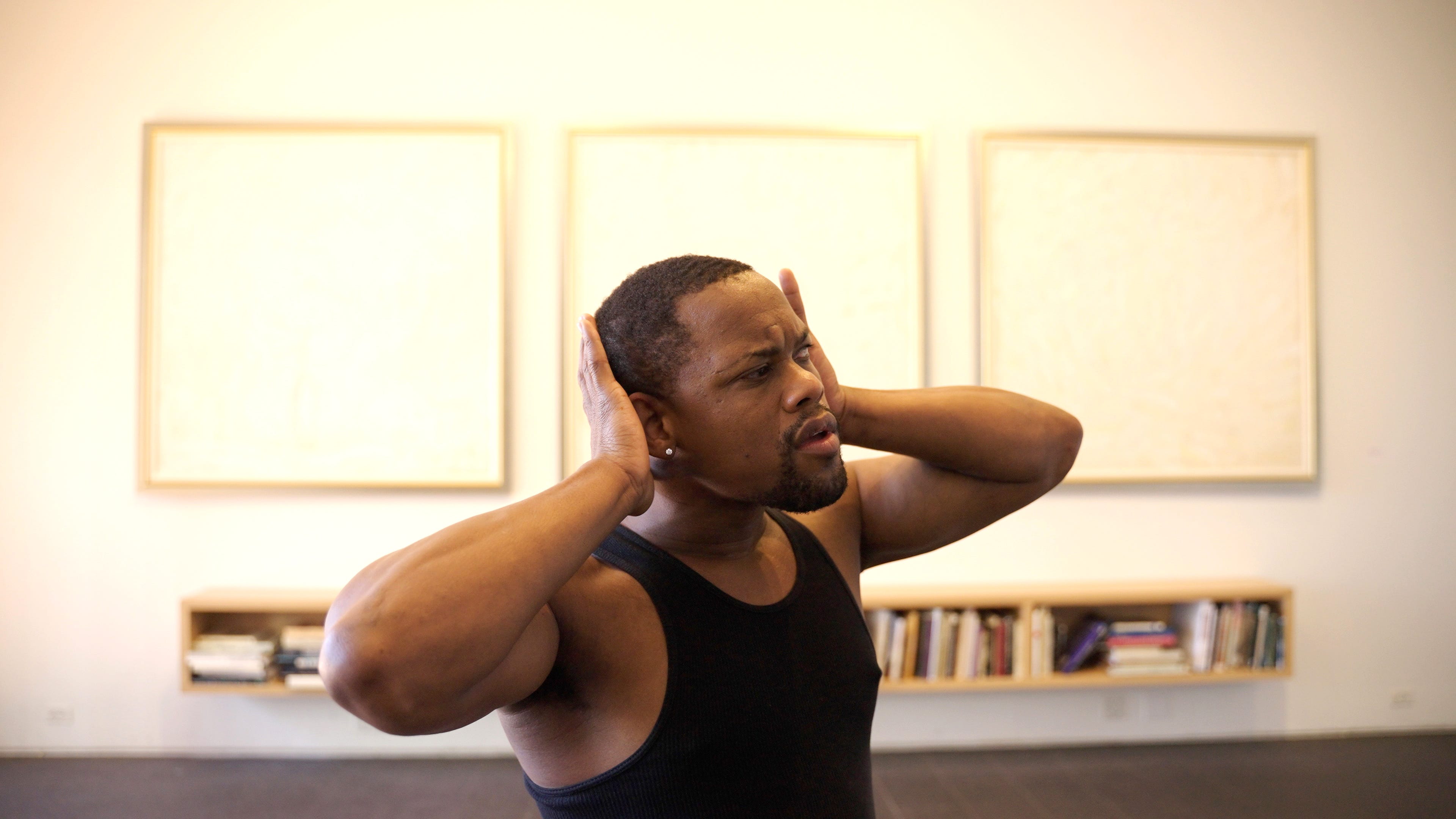
Davian Robinson served as co-curator with Janet Biggs for the “Collection, Reframed: We are Here, Beyond Vision” exhibit at Bechtler Museum of Modern Art, open through Sept. 22. (Photo courtesy of Bechtler Museum)
by Page Leggett
Davian “DJ” Robinson keeps a full schedule. The ballet dancer and massage therapist is training for a marathon and preparing for an October speaking engagement in India.
He recently co-curated an exhibition at the Bechtler Museum of Modern Art, open through Sept. 22, called “Collection, Reframed: We are Here, Beyond Vision.” (Earlier this summer, The Ledger wrote about the exhibition and how it was created.)
Robinson juggles a lot but manages to stay on top of it all.
Oh, and he’s blind.
At 33, Robinson has accomplished more than most. He credits his success not only to his own determination but also to the support of his parents, teachers and his faith.
‘I am a miracle’: Robinson, who grew up in Hickory, wasn’t born blind, but he weighed only 1 pound, 9 ounces at birth and wasn’t supposed to survive.
“I realized that not only am I a miracle, I had a purpose,” he said. “My life has been one of struggle, but also one of jubilation.”
He downplays his struggles, although being visually impaired wasn’t the only one. His father, who died before Robinson was 14, was in prison for most of Robinson’s childhood.
As a kid, Robinson endured a series of operations for his retinopathy, but they didn’t keep his sight from degenerating. He’d previously been able to see up to 20 feet away, but shortly before beginning his studies at UNC Charlotte in 2016, his vision had diminished to the point where he could only see shadows about four inches in front of him with his right eye. He sees nothing out of his left eye.
But he had begun learning at 12 how to live as a blind person. That’s when his mom sent him to Governor Morehead School in Raleigh, the state’s only residential school for the blind and visually impaired. There, he learned to use a cane, to navigate street crossings and to use screen readers.
As an adult, he has learned to use an Apple program called VoiceOver, in combination with Siri, to send and read emails on his phone or computer.
His life has been shaped by his optimism.
“My dad was still a great father,” he said. “He became a better man in prison. He told my brother and me, ‘Don’t be like me. Be better than me.’ From as early as I can remember, we never had a care. Never had a want. As a kid, I was naive; I didn’t realize my mom was working two and three jobs to hold down the fort after my dad went away.”
He understands now how much his mom, who died in 2022 from a stroke, sacrificed. She could be overprotective — not letting him play certain sports to protect what vision he had — but he knows it “came from a place of love.” (Robinson did become a Paralympic cyclist who went to 10 national championships and brought home six medals.)
He inherited the best of both parents and became, he said, “tough, compassionate, empathetic, outgoing and determined that whatever I start, I’ll finish.”
Reframing disability: During a college summer study abroad program in Italy, Robinson took a private lesson from Peter Brandenhoff, whose family had been part of the Royal Danish Ballet for three generations.
Robinson recalled Brandenhoff telling him, “The one thing you have that no one else has are these.” He pointed to the young dancer’s eyes. “You can’t see, but you have an innate awareness of your body.”
Sighted dancers rely on the mirror, but his teacher said, “You intuitively understand where your body needs to be.” To Brandenhoff, Robinson’s visual impairment wasn’t a disability to be overcome, but a gift to be celebrated.
Karen Hubbard, a now-retired dance professor at UNC Charlotte, told him, “I’ve never had a blind person in class, but let’s figure this out.”
In Hubbard’s vintage jazz class at UNC Charlotte, Robinson learned dances like the Big Apple, the Lindy Hop and the Shorty George, after they devised a way for Hubbard to teach her first blind student.
His teachers didn’t go easy on him because of his disability.
On a rough day in his West African dance class, Robinson was ready to give up. “I stopped, went to the side of the room and sat down,” he recalled. “[The professor] ended class early, came over to me and said: ‘Don’t ever do that again. Never stop moving. Never give up, no matter how hard it gets. You don’t know how you’re doing in relation to everyone around you. You may think you’ve got it rough, but you don’t know that everyone else around you is struggling at times, too.’”
He kept moving. In 2020, he was the first blind person to graduate from UNC Charlotte with a degree in dance. [Editor’s note: This article was updated on 8/29/25 with Robinson’s correct graduation year.]
What’s next: Robinson is working on a memoir tentatively titled “Pathways Beyond Myself: The Untold Story of Davian Robinson.”
He’s a disability activist working to “increase access in museums, performance spaces and all spaces that strive to give everyone a voice,” he said.
He knows some see his blindness and feel pity. “There’s a societal assumption that my life is somehow diminished because my eyes don’t work,” he said.
He wants to change that mindset. Disabled people are more than their disability, he said.
“I’m a person first,” he said. “I’m an artist, a massage therapist, a former athlete, a published poet, a father, a brother, a son. I have a strong faith in Christ. That’s who I am at my core.”
He didn’t mention “teacher” or “coach,” but he is both.
“Never give up; never give in to life’s challenges,” Robinson said. “Be willing to say yes. Because when you can say yes, life becomes easy. Life’s challenges don’t stop, but your own vision about where you want to go becomes a lot clearer. Saying ‘yes’ makes the impossible become possible.”
Page Leggett is a Charlotte-based freelance writer. Reach her at epageleggett@gmail.com.