Written by Dongmyung Ahn, for Voices and Accessibility tidbits, July 10, 2025
It was the first day of the spring semester, and I nervously watched as my lecture hall filled up with what ended up being 48 students for my music history class. As a second-generation Korean American with a difficult-to-pronounce name, I have always been a little apprehensive about first impressions.
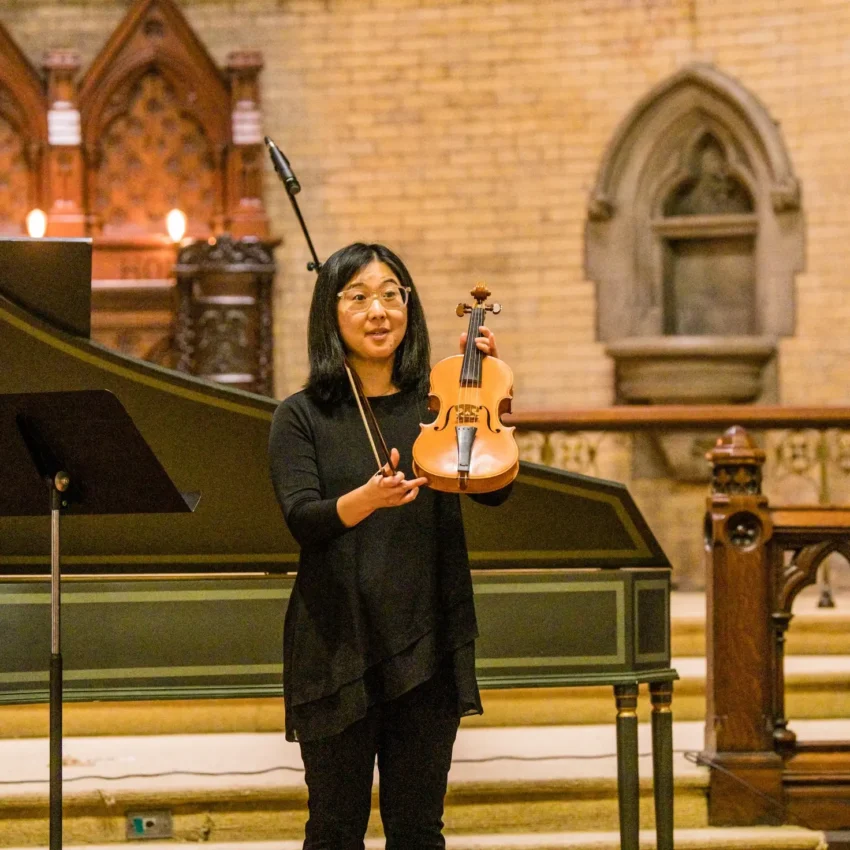
I stepped out from behind the podium on the stage, took a breath and smiled. “I’m Professor Ahn. I’ll be your instructor for the semester,” I told them. “I play early stringed instruments and specialize in the history of music from the Medieval, Renaissance and Baroque periods.”
“And I stutter,” I added.
Public speaking is an occupational hazard for former presidents, poets laureate, and college professors — basically, anyone who’s required to talk a lot. Faced with words on slide presentations (or teleprompters) that have pesky, plosive consonants and vexing vowels, even the most eloquent of orators can falter. This probability is multiplied if you possess a speech impediment.
I joined “the club,” as former President Joe Biden affectionately calls, it in fourth grade, when my speech disfluency further manifested itself after a trying time with two temperamental teachers.
According to the National Institute on Deafness and Other Communication Disorders, “normal” speech is produced through “precisely coordinated muscle movements controlled by the brain and monitored through our senses of hearing and touch.” However, for those of us with speech disorders, these movements are often short-circuited. A stutter can stymie your speech, replacing it with the skipping sounds of a scratched record.
Having mustered up enough centrifugal force from within to ask the ordinary, often transactional request — “Can I have a slice of p-p-plain pizza?” — I surprised even myself when I chose to become a teacher.
In middle school, some of my teachers deployed a bizarre and cruel tactic to prepare us for bullying in high school — they mocked us. In my case, instead of “Dongmyung,” they called me “Dumb-and-young,” essentially affixing a kind of mute spirit on me.
And yet, my love of music history placed me in the classroom, the opportunity to guide students from early chant to the aleatoric music of John Cage far outweighing any fear of public speaking.
Given what I went through, when I started teaching, I became my own Office of Special Services, if you will, providing modifications to help me manage my disability. I adopted a more conversational, less didactic approach to lecturing, as well as a more empathetic philosophy of teaching. I even started using the cheeky technique I had developed in college when I literally spelled words at people when I was stuck. The roles, then, were reversed, as others, not I, were forced to think on their feet.
Life with a speech impediment produces both humility and chutzpah — humility from having my voice thwarted continually, and chutzpah for persisting through it all.
I’ve since continued to normalize my disability simply by being present, in the unextraordinary act of showing up, whether or not I am stuttering less or more on a given day. Recently, in an unfiltered moment, I told my class, albeit inelegantly, about how an extreme stuttering spell can be the result of exhaustion. I was newly tethered to the reality that exposure and the sharing of information, ultimately, can both demystify and relieve.
This spring, I learned how the traditional teacher-student model could not only be flipped, but reshaped entirely.
“OK, class, Ite missa est (Latin for “Go, mass is over”), I said, tongue-in-cheek, hoping my students would get the nerdy teacher joke that “class,” not “mass,” was over. As most of the students packed up, Peter, a gregarious baritone, bounded up the stairs to the stage.
“Dr. Ahn,” he said enthusiastically but a little sheepishly, “I also have a s-s-s-stutter.” I noticed the telltale yet almost imperceptible blink that accompanied the misspoken word.
I was stunned.
“Wow, that’s great, I do, too!” I said, taken aback. In that moment, I experienced a welcome moment of camaraderie with my student. Although there are over 3 million people in the United States who have this verbal block, until that moment, I had only met one other face to face — the father of a friend from camp, whom I knew when I was a teenager.
Throughout the semester, I was heartened whenever Peter raised his hand to answer a question. I was impressed by his lack of self-consciousness. He never looked ashamed, and, in fact, he sometimes even grinned. It helped that he had a supportive band of classmates.
It was gratifying for me to witness such groundedness in him. When I was his age, I was an ever-reticent student, always terrified that a teacher would call on me, not necessarily because I wouldn’t know the answer, but because I feared being unable to articulate my response.
After the semester ended, Peter shared, in an email, how empowering it was to have a teacher who spoke like he did. His acknowledgement of our shared journey felt like a gift, helping me normalize what has always felt stigmatizing.
In disclosing our disabilities, our vulnerabilities, Peter and I unintentionally helped transform the academic space into something less hierarchical and more human — a place where students and teachers could both learn from and support each other as peers.
In my early years of teaching, I remembered hearing snickering from the class when I got stuck in lectures on “B-b-b-beethoven.” I wondered if the students’ skepticism was less because of my speaking style and more because they could sense how uncomfortable I was with myself.
I know now that the more I accept my verbal stumbles and talk openly about them, the easier it is for others like me to feel accepted.