
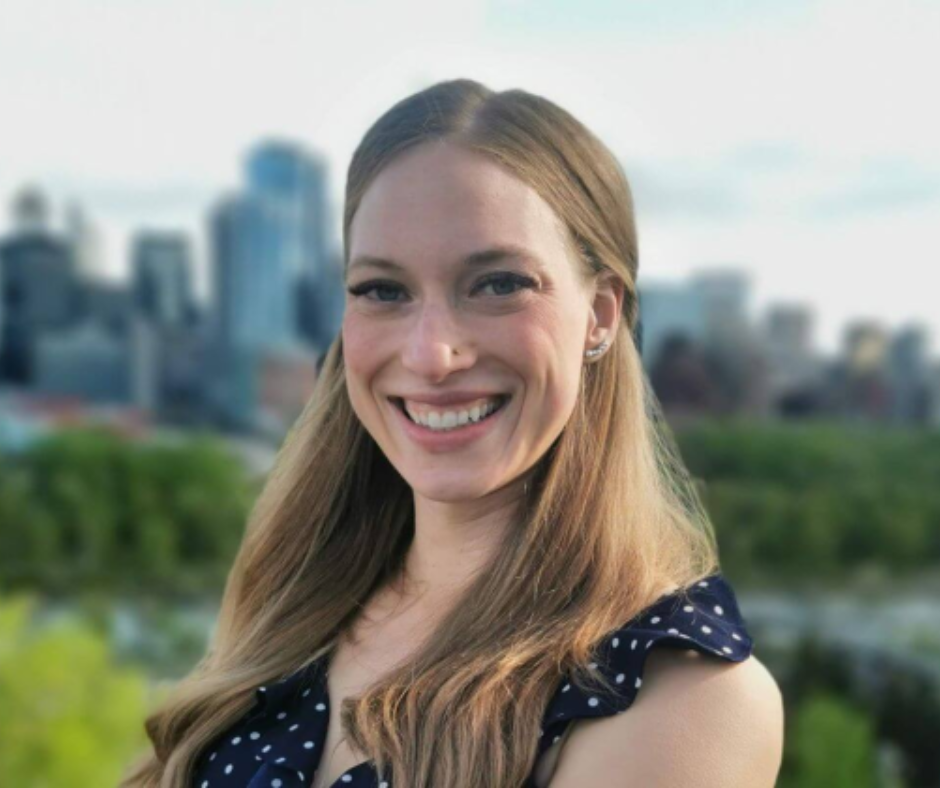
Written by Jenise Finlay, PhD Student, University of Victoria, March 10, 2026
Disability and sexuality are rarely discussed in the same sentence in healthcare settings.
But Jenise Finlay, a University of Victoria PhD student, is challenging that bias through a new study that explores the intimate lives of women living with chronic pain.
Finlay, a registered nurse and advanced practice nurse with more than 10 years of experience working in sexual health, is a Social Dimensions of Health student and prestigious Trudeau Scholar with the School of Public Health and Social Policy.
Since the age of 13, she has lived with debilitating symptoms of hypermobile Ehlers-Danlos syndrome (hEDS), a genetic condition that affects the body’s connective tissue. It took 15 years for doctors to diagnose her condition.
The crippling muscle pain caused by EDS forced Finlay to quit soccer, running, and playing the saxophone. She has had five major surgeries since 2018, with 21 rounds of prolotherapy, an injection treatment used to relieve joint, ligament and tendon pain.
For people living with largely invisible disabilities such as EDS, getting a medical diagnosis can be a long, frustrating journey. “You look fine, so you must be healthy” was a familiar refrain for Finlay.
Chronic pain and female health are often dismissed or not taken seriously. Considering that I was an emerging young adult, it was very isolating to feel like no one else understood.”
Jenise Finlay, PhD student
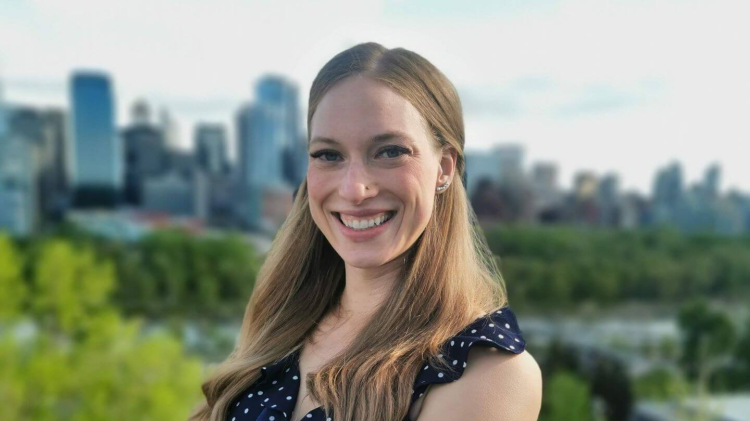
Jenise Finlay
The intimate lives of women with chronic pain
Finlay holds a Master of Nursing degree from the University of Calgary, and a Bachelor of Science in Nursing from Vancouver Island University. For her PhD study, she is recruiting individuals of reproductive age, living with chronic pain in the Calgary area, where she also lives.
For six months, Finlay will become immersed in her research participants’ lives, observing their routines, reviewing medical records, photographs and items of importance to them, and attending medical appointments. She will interview participants about their experiences accessing care for sexual and reproductive health while living with chronic pain.
“I’ll have very accessible research based on their lived experiences and storytelling,” Finlay says.
Her research will challenge common stereotypes and misunderstandings around sexuality and disability and fill a gap in academic literature. Finlay says people with disabilities often are seen as asexual, not capable of having partnerships or becoming parents. Or conversely, they might be categorized as hypersexual or infantilized if they have intellectual disabilities.
Jenise Finlay enjoys a beautiful lake and mountain view.
Educating the next generation of nurses
Finlay plans to make a short documentary to share her research findings and materials with healthcare providers, the public, and people living with chronic illnesses. Her goal is to reduce the stigma and misunderstanding around chronic illness and sexual health. She hopes to teach the next generation of nurses about sexual health and disability.
As a society we’re not prepared to talk about sex then you throw in disability. It’s often reduced to very mechanical ways of having sex versus seeing people and their sexuality as a whole.”
Jenise Finlay, PhD student
A proud advocate for people living with EDS, Finlay is president of the Alberta Society for the Promotion of Sexual Health and is a member of Statistics Canada’s Expert Advisory Committee on Sexual and Reproductive Health.
As part of her Trudeau Foundation scholarship, in which she receives $50,000 a year for three years, plus another $20,000 for travel-related study, Finlay recently presented at a world qualitative research conference in Spain.
And although it took time to accept her diagnosis of EDS, Finlay has since found other ways to stay active and healthy.
She rock climbs twice a week, lifts weights, hikes, skis and swims.
“Everybody’s different,” Finlay says. “I’m grateful for what I can do now.”